

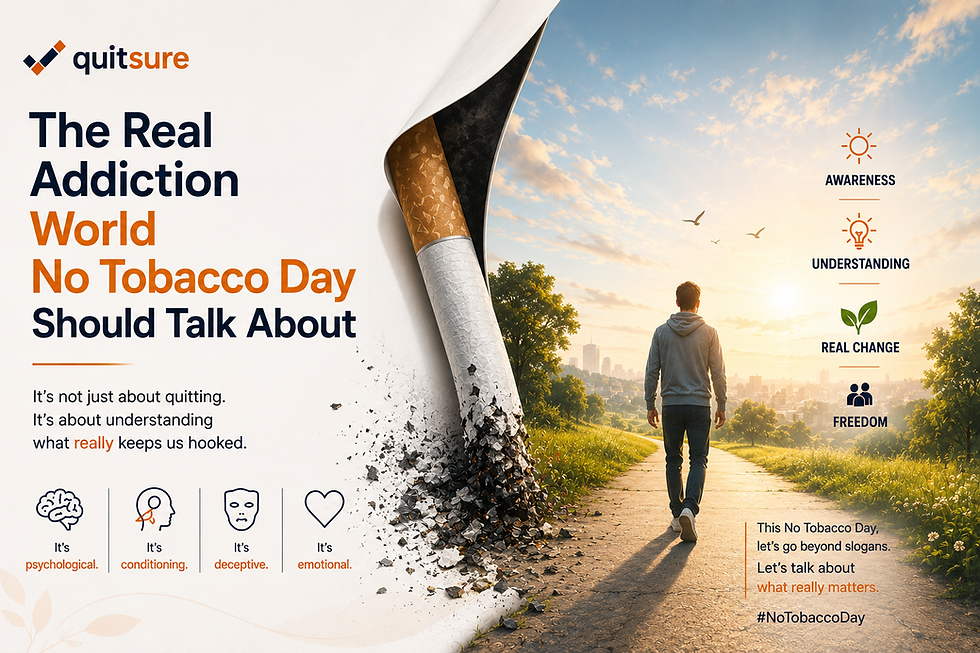
The Real Addiction World No Tobacco Day Should Talk About

Most smokers already know cigarettes are harmful.
World No Tobacco Day does not reveal any hidden truth that smokers have never heard before. Most smokers already understand that smoking damages the lungs, affects the heart, increases cancer risk, drains money, reduces energy, and slowly impacts nearly every part of the body.
Yet millions still continue smoking.
Not because they are unaware. Not because they “don’t care.” And often, not even because they genuinely enjoy cigarettes anymore.
For many smokers, the real addiction eventually becomes emotional.
At some point, smoking stops feeling like a bad habit and starts feeling like emotional support. Cigarettes slowly become connected to stress relief, comfort, familiarity, loneliness, overthinking, work pressure, emotional exhaustion, or simply the feeling of needing a break from life for a few minutes.
And this is the side of smoking addiction that World No Tobacco Day rarely talks about deeply enough.
How Cigarettes Quietly Become Emotionally Important
Most smokers do not notice when the relationship with cigarettes changes.
In the beginning, smoking may feel occasional, social, experimental, or even controllable. But over time, cigarettes slowly begin attaching themselves to emotional moments throughout daily life.
A cigarette after a stressful meeting. Smoking during loneliness. Lighting one after arguments. Smoking during anxiety. Smoking with coffee. Smoking while overthinking late at night. Smoking during boredom or emotional exhaustion.
The brain quietly records these moments.
Over time, it begins building a learned emotional pattern where discomfort becomes connected to cigarettes and cigarettes become connected to temporary relief.
Eventually, many smokers stop consciously deciding to smoke. The behaviour becomes automatic because the brain starts expecting cigarettes whenever emotional discomfort appears.
Research published by the National Library of Medicine has shown that emotional and environmental cues become deeply associated with smoking behaviour over time. These conditioned patterns can continue triggering cravings even after physical nicotine withdrawal begins to reduce.
This is why many smokers relapse during stressful periods, even when they genuinely want to quit.
The addiction quietly becomes psychological.
The Psychological Trap Most Smokers Don’t Realise They’re Living In
Many smokers genuinely believe cigarettes help them cope emotionally.
They say things like:
“Smoking relaxes me.”
“It helps me deal with stress.”
“It calms my nerves.”
“I just need one to clear my head.”
The feeling seems real.
But addiction psychology shows something very different is often happening underneath.
Nicotine creates a cycle where withdrawal discomfort slowly builds throughout the day. As nicotine levels drop, many smokers begin experiencing subtle restlessness, irritability, tension, anxiety, emotional discomfort, or difficulty concentrating without fully recognising these sensations as withdrawal.
When another cigarette is smoked, that discomfort temporarily reduces.
The brain then interprets the experience as emotional relief:
“Smoking helped me calm down.”
But in many cases, the cigarette temporarily relieved the discomfort that nicotine itself had helped create earlier.
This becomes one of the biggest psychological traps in smoking addiction. The cigarette appears to solve a problem while quietly reinforcing the cycle underneath.
A study published in the British Journal of Psychiatry found smokers consistently report higher overall stress levels than non-smokers and successful quitters, despite believing cigarettes help reduce stress.
The relief feels real. But the brain is often mistaking withdrawal relief for emotional comfort.
Why Smoking Eventually Starts Feeling Automatic
This is the part many smokers struggle to explain.
Even when cigarettes stop feeling enjoyable, the urge to smoke often continues automatically.
Many smokers notice themselves lighting cigarettes during stressful work calls, after meals, while driving, during loneliness, with coffee, after arguments, or while overthinking late at night without consciously thinking much about it at all.
The smoking pattern becomes deeply conditioned.
After years of repetition, the brain stops asking:“Do I actually want this cigarette?”
Instead, cigarettes begin functioning like emotional reflexes connected to stress, routine, and emotional discomfort.
This is why smokers often describe cigarettes as:
“My comfort.”
“My break.”
“My escape.”
“The only thing that calms me down.”
A behavioural study published in Addiction Research & Theory found many smokers describe cigarettes as emotionally symbolic objects associated with comfort, familiarity, emotional safety, and routine rather than simple nicotine delivery tools.
That emotional attachment is often the real addiction many smokers silently struggle with.
Why Quitting Smoking Can Feel Emotionally Frightening
Many smokers are not only afraid of nicotine withdrawal.
They are afraid of what life will feel like emotionally without cigarettes.
Some quietly wonder:
“How will I cope with stress?”
“What replaces my smoke breaks?”
“What if life feels empty without smoking?”
“How will I calm myself down?”
“Who am I without this habit?”
These fears are emotional, not rational.
Smoking slowly becomes connected to identity, emotional regulation, routine, comfort, social confidence, and temporary relief during difficult moments.
This is one reason quitting can sometimes feel less like removing a harmful habit and more like losing emotional support.
And this is exactly why awareness alone is often not enough.
Most smokers already know cigarettes are harmful. The real challenge is understanding the emotional conditioning underneath the habit.
Why Psychology-Based Approaches Are Changing the Smoking Conversation
Traditional anti-smoking messaging often focuses heavily on physical health risks.
But psychology-based approaches focus on something deeper:Why cigarettes feel emotionally important in the first place.
Because smoking addiction often operates at multiple levels - conscious thoughts, emotional beliefs, and subconscious behavioural conditioning.
A smoker may logically understand cigarettes are harmful, while emotionally believing:
“Smoking helps me relax.”
“I need cigarettes during stress.”
“Life without smoking will feel incomplete.”
“Smoking helps me cope emotionally.”
These beliefs become deeply conditioned through repetition over the years.
Cognitive Behavioural Therapy (CBT) works on conscious thought distortions such as:
“Smoking relaxes me.”
“I enjoy cigarettes.”
“I need cigarettes to focus.”
Rational Emotive Behaviour Therapy (REBT) goes deeper into emotional beliefs, like:
“I cannot cope without smoking.”
“I am a smoker.”
“Life without cigarettes will feel empty.”
But smoking addiction also operates subconsciously.
After years of repetition, situations like stress, coffee breaks, driving alone, finishing work, loneliness, emotional overwhelm, or late-night overthinking can begin triggering cigarettes automatically before conscious thought fully begins.
This is why many psychology-based smoking cessation approaches now focus heavily on behavioural conditioning and subconscious smoking patterns rather than nicotine alone.
The Moment Smokers Begin Seeing the Trap Clearly
Most smokers smoke automatically.
They light the cigarette before consciously thinking about it.
But something interesting happens when smokers are asked to slow down completely and observe the cigarette carefully instead of smoking mechanically through habit.
When smokers pay close attention to the taste, smell, heaviness, irritation in the throat, repetitive sensation, and emotional expectation attached to smoking, many begin noticing something uncomfortable:The actual experience often feels far less satisfying than the brain has been promising for years.
QuitSure uses psychology-based behavioural approaches combined with mindful smoking techniques designed to help smokers consciously observe the smoking experience rather than repeating it automatically.
Instead of forcing immediate deprivation, the program allows smokers to continue smoking until the final stage while gradually exposing the psychological illusion underneath the habit.
The goal is not simply to “fight cravings.” It is to help smokers recognise how emotional conditioning and subconscious associations created the feeling that cigarettes were helping in the first place.
And once smokers begin seeing the trap clearly, smoking often starts feeling very different.
A peer-reviewed study published in JMIR Human Factors in 2024 found that 80.1% of 1,286 program completers maintained prolonged abstinence for 30 days or more. Among participants who remained abstinent, 86.4% reported no severe withdrawal symptoms.
What World No Tobacco Day Should Really Remind Smokers
World No Tobacco Day absolutely matters.
But beyond the health warnings, it should also acknowledge something millions of smokers quietly experience every day:smoking addiction is often emotional, behavioural, and psychologically conditioned over the years.
Many smokers are not weak. They are not “failing.” And they are not simply lacking willpower.
They are responding to emotional patterns the brain has repeated thousands of times.
Understanding those patterns changes the quitting conversation completely.
Because once smokers begin recognising the psychological trap behind cigarettes clearly, quitting often stops feeling like losing something - and starts feeling like escaping something.
Ready to Understand the Psychology Behind Smoking?
Many smokers spend years believing cigarettes genuinely help with stress, comfort, focus, or emotional coping. But much of smoking addiction is built through repeated behavioural conditioning and subconscious emotional patterns over time.
QuitSure App is designed to help smokers understand the psychological side of addiction, including emotional triggers, subconscious smoking habits, stress-linked conditioning, and the mental associations that keep cigarettes feeling emotionally important.
Understanding the real addiction behind smoking can become one of the first steps toward breaking the cycle.
FAQs
What is World No Tobacco Day?
World No Tobacco Day is observed every year on May 31st to raise awareness about the harmful effects of tobacco use and encourage smokers to quit.
Why is smoking addiction often psychological?
Over time, cigarettes become emotionally linked to stress relief, routines, comfort, loneliness, and behavioural habits, making smoking psychologically conditioned beyond physical nicotine dependence.
Why do smokers feel emotionally attached to cigarettes?
The brain gradually associates cigarettes with temporary emotional relief and coping patterns through repeated smoking during stressful or emotional situations.
Can behavioural conditioning make quitting harder?
Yes. Subconscious smoking routines connected to stress, coffee, loneliness, work breaks, or emotional triggers can continue creating cravings even after physical withdrawal improves.
References
World Health Organization - World No Tobacco Day: https://www.who.int/campaigns/world-no-tobacco-day
National Library of Medicine - Cue Reactivity and Nicotine Dependence Researchhttps://pmc.ncbi.nlm.nih.gov/articles/PMC2907831/
British Journal of Psychiatry - Smoking and Stress Researchhttps://www.cambridge.org/core/journals/the-british-journal-of-the-psychiatry/
Addiction Research & Theory – Emotional Symbolism in Smoking Behaviour:https://www.tandfonline.com/journals/iart20
JMIR Human Factors - QuitSure Smoking Cessation Study: https://humanfactors.jmir.org/
American Psychological Association - Addiction and Behavioural Conditioning


