

Understanding the Emotional Attachment to Smoking

Most smokers know cigarettes are harmful.
They know smoking affects health, energy levels, breathing, finances, confidence, and long-term well-being. Many smokers genuinely want to quit. Some even attempt quitting multiple times.
Yet despite understanding the risks, cigarettes can still feel emotionally difficult to let go of.
This is where smoking addiction becomes far more complicated than nicotine alone.
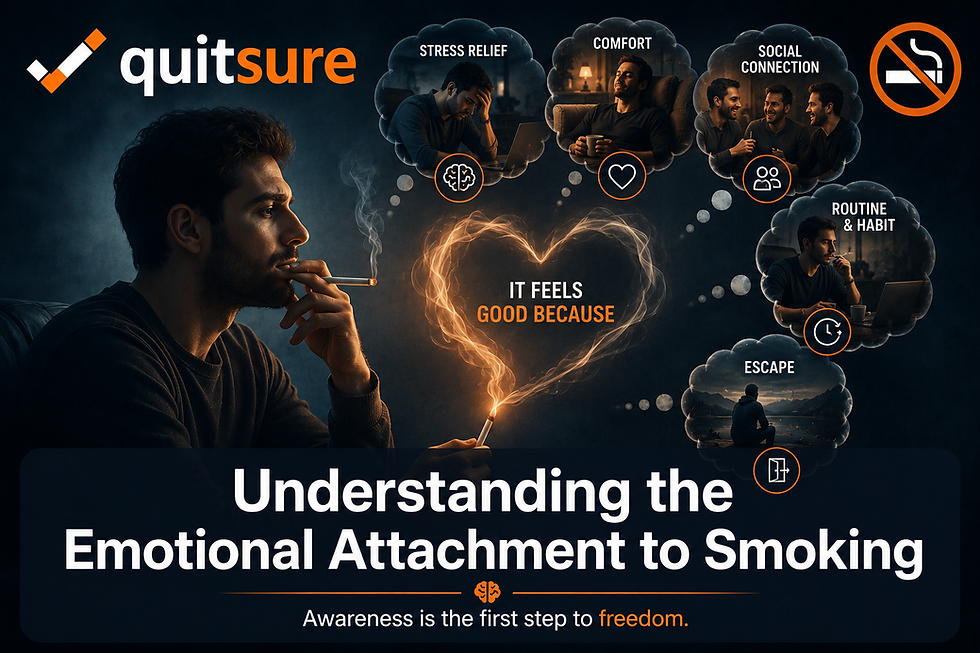
For many smokers, cigarettes become emotionally attached to comfort, stress relief, familiarity, identity, routines, loneliness, emotional escape, or moments of calm during overwhelming situations. Over time, smoking stops feeling like just a physical habit and starts feeling emotionally important.
That emotional attachment is one of the strongest reasons smoking can feel difficult to leave behind.
Smoking Often Becomes Emotionally Conditioned Over Time
The emotional attachment to smoking usually develops gradually.
A cigarette during stress. A smoke break after work. Smoking during loneliness. Smoking while drinking coffee. Smoking after arguments. Smoking during anxiety. Smoking during boredom.
The brain quietly records all of these moments.
Over time, cigarettes become associated with emotional relief and familiarity. The brain starts building a learned behavioural loop:
Emotion → Cigarette → Temporary Relief
The more often this cycle repeats, the stronger the emotional conditioning becomes.
This is why many smokers instinctively reach for cigarettes during emotionally uncomfortable situations, even before consciously thinking about it.
Research published by the National Library of Medicine has shown that emotional cues and environmental routines become deeply connected to smoking behaviour over time. These behavioural associations can remain powerful even after physical nicotine withdrawal begins to reduce.
In simple terms, the brain starts treating cigarettes as emotional coping tools.
Why Cigarettes Start Feeling Emotionally Important
Most smokers do not become attached to cigarettes because they genuinely enjoy every cigarette.
In fact, many smokers admit cigarettes often taste unpleasant, feel repetitive, or no longer provide the satisfaction they once expected. Yet the urge to smoke still remains strong.
This happens because the brain slowly stops chasing pleasure and starts chasing relief.
Nicotine reaches the brain within seconds after inhalation and stimulates dopamine release. Dopamine is linked to reinforcement, reward, temporary relief, and habit learning.
But nicotine levels also fall quickly. As withdrawal discomfort slowly returns throughout the day, another cigarette temporarily reduces that discomfort again.
Over time, the brain begins misinterpreting this cycle as emotional comfort.
This creates one of the most powerful psychological traps in smoking addiction:The cigarette feels emotionally supportive because it briefly relieves the discomfort nicotine itself helped create.
A study published in the British Journal of Psychiatry found smokers commonly report smoking for relaxation and stress relief despite consistently showing higher overall stress levels than non-smokers and successful quitters.
The emotional comfort feels real, but the cycle underneath is often driven by conditioning and withdrawal reinforcement.
Emotional Attachment Often Becomes Stronger Than Physical Addiction
One of the biggest misconceptions about smoking is that addiction is purely physical.
But behavioural experts increasingly recognise that emotional attachment often becomes the dominant part of smoking addiction, especially for long-term smokers.
For some people, cigarettes become emotionally linked to:
Comfort during stress, moments of isolation, emotional escape, social confidence, work breaks, loneliness, personal routines, or even identity itself.
This explains why cravings can suddenly appear during emotional situations, even after physical nicotine withdrawal has improved.
A smoker may no longer be physically dependent in the same way, but emotionally, the brain still remembers cigarettes as a coping mechanism.
A 2023 behavioural addiction review found emotional triggers remain among the strongest predictors of smoking relapse. Stress, emotional overwhelm, routine disruption, and loneliness consistently reactivate smoking urges because the brain has learned to associate cigarettes with emotional regulation.
This is why quitting often feels emotional rather than simply physical.
Smoking Can Quietly Become Part of Identity
For many long-term smokers, cigarettes slowly become woven into identity and daily life.
Smoking can become attached to:
Morning routines, socialising, stress management, creativity, emotional pauses, nightlife, independence, work culture, or personal comfort rituals.
Eventually, smokers may begin asking themselves questions they rarely say out loud:
“How will I cope without smoking?”
“What replaces my smoke breaks?”
“Will life feel emptier?”
“How do I relax without cigarettes?”
“Who am I without this habit?”
These fears are emotional, not rational.
A study published in Addiction Research & Theory found many smokers describe cigarettes not simply as nicotine delivery tools, but as emotionally symbolic objects associated with comfort, familiarity, safety, and behavioural routine.
This emotional identity attachment is one reason quitting can feel psychologically frightening, even when smokers genuinely want freedom from cigarettes.
Why Traditional Quitting Advice Sometimes Feels Incomplete
Many smokers become frustrated because traditional quitting advice focuses mainly on nicotine dependence.
But emotional smoking habits often operate at multiple levels:conscious thoughts, emotional beliefs, and subconscious behavioural conditioning.
A smoker may consciously know smoking is harmful while emotionally believing:
“Smoking relaxes me.”
“I need cigarettes during stress.”
“Life without smoking will feel empty.”
“Smoking is part of who I am.”
These emotional convictions are powerful because they are reinforced repeatedly over the years.
This is one reason psychology-based smoking cessation approaches have gained increasing attention in behavioural addiction research.
How Psychology-Based Programs Approach Emotional Smoking
Psychology-based smoking cessation approaches focus on dismantling the emotional and subconscious attachment to cigarettes rather than only removing nicotine.
Cognitive Behavioural Therapy (CBT) helps challenge conscious thought patterns like:
“Smoking helps me relax.”
“I enjoy cigarettes.”
“I need smoking to focus.”
The goal is to help smokers examine whether these beliefs genuinely match their lived experience.
Rational Emotive Behaviour Therapy (REBT) goes deeper into emotional identity beliefs, such as:
“I am a smoker.”
“I cannot cope without cigarettes.”
“Life without smoking will feel incomplete.”
These emotional beliefs often operate beneath logical thinking and become strongly conditioned over time.
Some psychology-based approaches also work on subconscious smoking associations. Certain triggers - after meals, during stress, with coffee, while driving, or during emotional discomfort - can activate smoking urges automatically before conscious thought even begins.
This is why behavioural conditioning becomes such an important part of smoking addiction.
QuitSure combines psychology-based behavioural approaches with mindful smoking techniques designed to help smokers observe cigarettes consciously rather than automatically.
During the program, smokers pay close attention to the actual experience of smoking - the taste, smell, physical sensation, emotional expectation, and mental response - instead of smoking mechanically through habit.
This process helps expose one of the central psychological traps in smoking addiction:The brain often promises emotional comfort and satisfaction that the actual cigarette experience does not fully deliver.
The program also allows smokers to continue smoking until the final stage instead of forcing immediate deprivation. This helps reduce the panic and resistance many smokers feel when they believe cigarettes are suddenly being “taken away.”
A peer-reviewed study published in JMIR Human Factors in 2024 found that 80.1% of 1,286 program completers maintained prolonged abstinence for 30 days or more. Among participants who remained abstinent, 86.4% reported no severe withdrawal symptoms.
This growing focus on behavioural and emotional conditioning reflects a larger shift in understanding smoking addiction psychologically, rather than viewing it only as nicotine dependence.
Why Emotional Cravings Feel So Intense
Emotional cravings often feel powerful because they are tied to memory, routine, emotional relief, and subconscious conditioning.
The brain remembers repeated emotional patterns extremely efficiently.
If cigarettes repeatedly appeared during stress, loneliness, anxiety, exhaustion, or emotional overwhelm for years, the brain begins expecting smoking whenever those emotions return.
This is why cravings can suddenly appear during:
Stressful deadlines, emotional conflict, loneliness, overthinking, social discomfort, or difficult life periods.
In many cases, the craving itself is less about nicotine and more about the emotional pattern the brain has learned to expect.
Final Thoughts
Smoking addiction is often far more emotional than smokers initially realise.
Over time, cigarettes become connected to comfort, routine, emotional escape, familiarity, stress relief, identity, and subconscious coping patterns. The brain slowly learns to associate smoking with emotional regulation, making cigarettes feel psychologically important during difficult moments.
This emotional attachment does not mean smokers are weak. It reflects how strongly the brain learns repeated emotional behaviours over time.
Understanding the emotional side of smoking is often one of the most important steps toward breaking the cycle and separating genuine emotional needs from learned smoking conditioning.
Ready to Understand the Psychology Behind Smoking?
Many smokers spend years believing cigarettes genuinely help them cope emotionally, relax during stress, or feel more stable during difficult moments. But emotional attachment to smoking is often built through repeated behavioural conditioning over time.
QuitSure App is designed to help smokers understand the psychological side of addiction, including emotional triggers, subconscious smoking patterns, stress-linked habits, and behavioural conditioning that keeps cigarettes feeling emotionally important.
Recognising how emotional attachment develops can become one of the first steps toward breaking the smoking cycle.
FAQs
What is emotional attachment to smoking?
Emotional attachment to smoking happens when cigarettes become psychologically connected to comfort, stress relief, routines, loneliness, identity, or emotional coping patterns over time.
Why do cigarettes feel emotionally comforting?
The brain gradually learns to associate cigarettes with temporary emotional relief, familiarity, and behavioural comfort through repeated smoking during emotional situations.
Can emotional attachment cause smoking relapse?
Yes. Emotional triggers such as stress, loneliness, anxiety, or emotional overwhelm are among the strongest relapse causes because the brain remembers cigarettes as emotional coping tools.
Is smoking addiction more psychological or physical?
Smoking addiction usually includes both physical nicotine dependence and psychological conditioning. For many long-term smokers, emotional habits become a major part of the addiction cycle.
References
National Library of Medicine – Cue Reactivity and Nicotine Dependence Research https://pmc.ncbi.nlm.nih.gov/articles/PMC2907831/
British Journal of Psychiatry – Smoking and Stress Research: https://www.cambridge.org/core/journals/the-british-journal-of-psychiatry
Addiction Research & Theory – Emotional Symbolism in Smoking Behaviour: https://www.tandfonline.com/journals/iart20
JMIR Human Factors – QuitSure Smoking Cessation Study: https://humanfactors.jmir.org/
American Psychological Association – Addiction and Behavioural Conditioninghttps://www.apa.org/topics/substance-use-abuse-addiction
University College London – Smoking, Stress and Mental Health Findings:
https://www.ucl.ac.uk/news/2013/jan/quitting-smoking-reduces-stress-anxiety-and-depression


